GOLDEN LION TAMARIN MONKEY

Resembling a lion but weighing in at just a pound, the golden lion tamarin monkey is one of Mother Nature’s more unique creations. With just 800 of these tiny monkeys left in the wild, spotting one is no easy task.
Your best chance of an encounter is to head to the lowland areas of the Brazilian Amazon, their last natural habitat. Visit the jungle in the morning while the monkeys are out looking for food.
JAGUARS
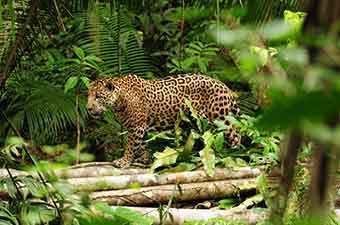
Though the habitat of these solitary big cats stretches from Mexico to Argentina, many can be found in the Brazilian Amazon and the region offers some of the best chances for spotting this illusive feline.
As the jaguar has one of the strongest bites of any big cat, it’s best to join one of the organized Amazon jungle expeditions in order to stay safe as you search for the jaguar.
POISON DART FROG

This brightly coloured and often poisonous species can be found across the Amazon, and favours humid, tropical habitats. If you want to get up close to a poison dart frog, take a trip to the Ceiba trail in Peru, a well-known frog habitat.
AMAZONIAN MANATEE

Like many of the rarest Amazon rainforest animals, the manatee is under threat due to hunting and the destruction of its habitat. It can be found living in freshwater habitats in the Brazilian, Colombian, Peruvian and Ecuadorian parts of the Amazon, but the murky waters of its preferred living areas can make a sighting more difficult.
RIVER DOLPHIN

Amazon river dolphins can be found throughout the rainforest region but are most plentiful in the lowland areas that are prone to large scale flooding.
If you’re joining a cruise through the Amazon Basin, you should be able to spot these pink-tinted creatures from the decks of your jungle ship, or for a closer look you can join an excursion deeper into the flooded rainforest.
Amazon Rainforest animals are often illusive, but by travelling with an expert guide and doing your homework, you can increase your chances of spotting some of the world’s rarest creatures.
THE SOUTH AMERICAN TAPIR

This adorable creature is one of the three big animals visitors hope to see in the jungle, along with jaguars and the giant otter. The hoofed mammals are surprisingly nimble given their bulky appearance and they feed on clay licks found in the jungle. Tapirs have come under threat as a result of illegal hunting and due to their habitat being destroyed by human activity.
GIANT OTTERS

Among the cutest animals in the Amazon Rainforest, giant otters can grow up to 1.7 metres long and can be found in the waterways that run through the jungle. They live in families consisting of two monogamous parents and often two or three offspring. Dependent on both the land and the water for survival, the giant otters are rapidly dying off as a result of deforestation and water contamination.
WHITE-CHEEKED SPIDER MONKEY

Another cheeky tree-dweller has seen its number dwindle due to the expansion of farmland in the Amazon and the building of new roads through the region. The white-cheeked spider monkey may not be swinging through the trees for much longer if conservation efforts are not ramped up.
HYACINTH MACAW

So far we have looked at land animals, but we must not forget our winged friends that soar up above. The hyacinth macaw is an astonishingly beautiful bird, with feathers in rich blues and green. The main threat to the survival of this magnificent bird is the illegal pet trade. Unfortunately, there is a market for these birds due to their splendour and this is reducing the numbers found in the wild.
THREE-TOED SLOTH

These slow, furry, long-limbed mammals spend 80% of their time snoozing; when they do move it’s at a heady two metres a minute. They sleep curled up in trees or hanging from branches. The two three-toed species are the types most frequently seen; they are well camouflaged (algae grows in their fur) and largely stationary; they favour trees of the Cecropia genus. Sometimes they’re seen crossing rivers (they’re good swimmers).
 SAVE AMAZONIA BLOG